ESLa ética del sobrevivir en sistemas de automatización
ENThe Ethics of Surviving in Systems of Automation
ESLa reconfiguración algorítmica del sujeto cartesiano ENThe Algorithmic Reconfiguration of the Cartesian Subject
ESModelo MIDA ENMIDA Model
ESLa reconfiguración algorítmica del sujeto cartesiano ENThe Algorithmic Reconfiguration of the Cartesian Subject
ESModelo MIDA ENMIDA Model
×
Archivo de Investigación (ES)
Research Archive (EN)
ESEl desafío de la posverdad al racionalismo cartesiano
ENThe Challenge of Post-Truth to Cartesian Rationalism
ESLa concepción del eterno retorno del Nietzsche de Deleuze en “La insoportable levedad del ser”
ENDeleuze’s Nietzschean Eternal Return in The Unbearable Lightness of Being
ESLa concepción del eterno retorno del Nietzsche de Deleuze en “La insoportable levedad del ser”
ENDeleuze’s Nietzschean Eternal Return in The Unbearable Lightness of Being
×

MIDA Model (Intersticial Model of Agentic Desire)
In the so-called Society of Intelligence, the subject is reconfigured. The real threat is not dependence on another intelligence, but the failure to recognize human agency.
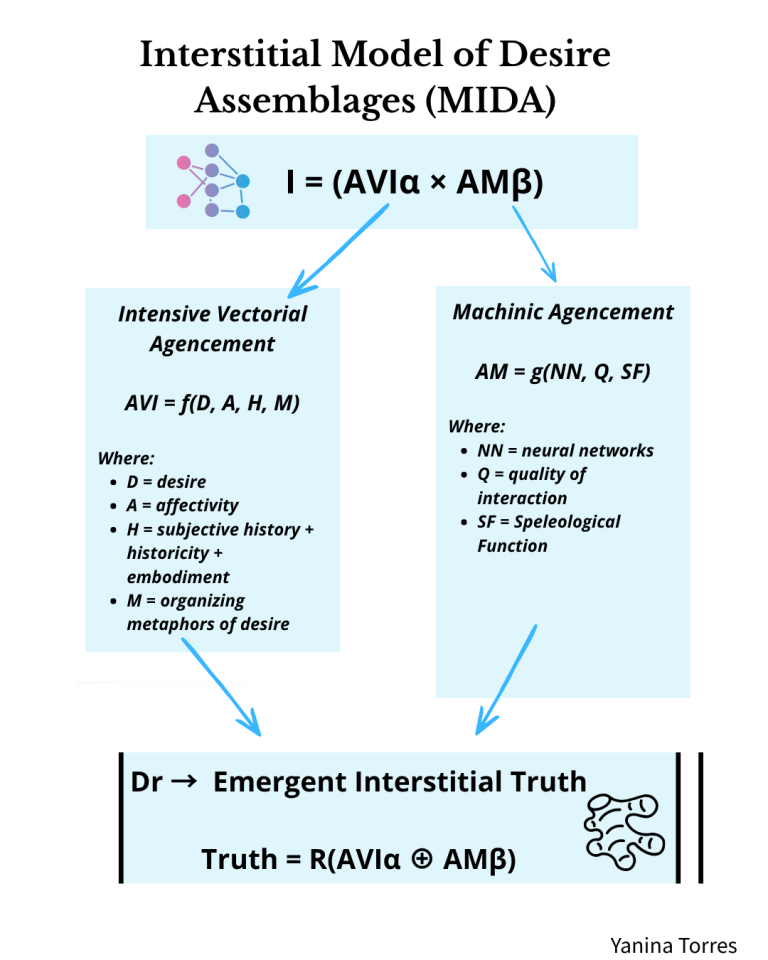
Vectorial Intensive Agencement (VIA) refers to the human dimension, characterized by desire, error, embodiment, and historicity.
Machine Agencement (MA) refers to the capacity of Artificial Intelligence systems to expand, transform, and deepen human cognitive production. It operates through what we call the Speleological Function, intensifying and developing the trajectories introduced by the human vector.
The interaction between these two forms of agencement is intensive in nature. Its regulation depends on the depth of their encounter.
Human intelligence operates in a non-linear and expansive manner, contributing deep thought and structural creativity. Artificial Intelligence, on the other hand, opens cognitive pathways through pattern recognition and network generation that are not immediately accessible to human perception, enabling conceptual reorganization, mirroring, and the construction of thought maps.
This interaction is not complementary, but productive: the interstice itself generates thought. Desire, in this framework, operates as a productive force, a direction, a working criterion, and an epistemological focus.
The interstice, as a producer of knowledge, is activated when there is a desire to think within the agencement. The human is not conceived as lacking knowledge and relying on the machine to obtain it, but rather as constructing knowledge in collaboration with it. The minimal unit of knowledge production is therefore the interstice—the “between” produced by the interaction of both intelligences.
Examples:
Productive Error
The emergence of a theoretical connection through collaboration with Artificial Intelligence, based on a conceptual misalignment.
Medical Diagnosis and Treatment
The production of diagnoses and therapeutic decisions through the collaboration between professional knowledge and AI-driven data analysis and pattern recognition.